December 25th, 2009 by JJW
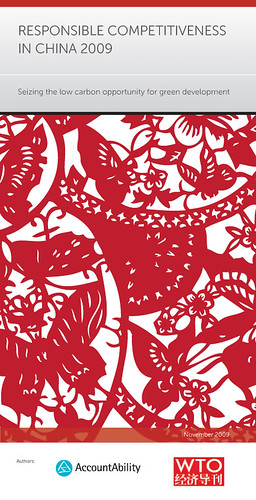
On November 30, I joined colleagues at the EU China Business Summit in Nanjing, Jiangsu, which dovetailed with the EU-China political meeting.
That day in Nanjing, under support from the Sino-Swedish Corporate Social Responsibility cooperation, AccountAbility launched the report Responsible Competitiveness in China 2009: Seizing the low carbon opportunity for green development.
This from AccountAbility:
Businesses in China are increasingly working with government and civil society to shift markets to reward sustainable development. These responsible business practices are becoming more and more embedded in the country’s emerging green industrial policy and low carbon development pathways. In some areas, China is set to leapfrog into the elite group of global green innovators.
These are some of the highlights from the report ‘Responsible Competitiveness in China 2009: Seizing the low carbon opportunity for green development’, launched at the 5th annual EU-China Business Summit as part of the Swedish EU presidency on 30 November in Nanjing, China.
The analysis presented in this report shows that China is developing a distinctive low carbon, responsible pathway, namely that:
- Low carbon industrial policies offer Chinese businesses and consumers huge opportunities
- Responsible business ventures in China are now impacting global markets relaunching China’s brand
- Strong government leadership, incentives and supportive policies are playing key roles
The report was independently researched and written in a unique collaboration between AccountAbility and the China WTO Tribune, with support from the Sino-Swedish CSR Cooperation Project. Learn more about the report’s key findings.
The Joint Statement of the 12th EU-China Summit specifically “decided to strengthen high-level dialogue and exchanges between think-tanks from both sides, and to promote and support regular exchanges.” Read the Joint Statement in full. AccountAbility’s partnership with the China WTO Tribune is an example of this kind of knowledge and collaboration exchange.
November 18th, 2009 by JJW
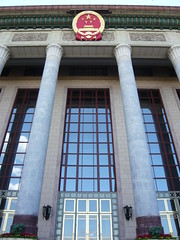 I took Obama’s visit as a chance to write about how company action should play a more prominent role in the trust building and competitiveness equation of the Sino-US relationship. My Guardian article, A green call to arms, (link to Chinese version here) centers on climate change. Meanwhile, my ChinaDialogue piece, Obama’s China moment (and the Chinese version) addresses wider issues of corporate social responsibility. I focus especially on sustainability standards and other global “rules of the game” that the US and Chinese governments should encourage companies to improve jointly.
Guardian: A green call to arms (Chinese)
ChinaDialogue: Obama’s China moment (Chinese)
May 5th, 2009 by JJW
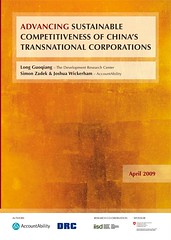 A Paper by Long Guoqiang, Simon Zadek, and Joshua Wickerham
AccountAbility’s Managing Partner, Simon Zadek, launched this report at the Boao Forum this year in Hainan and at the China Entrepreneur Club’s Daonong Green Companies Forum in Beijing. This paper is part of a two-year study with the State Council’s Development Research Center on “China’s sustainable trade strategy” working with several central-level Chinese research organizations and three international think tanks.
This paper examines how the Chinese business community can best use international sustainability standards to enhance their competitiveness in global markets and more effectively place themselves on a sustainable economic pathway.
It highlights the opportunity for Chinese businesses, supported by enabling public policies, to become a force in shaping the next generation of sustainability standards in global markets as a competitive strategy consistent with China’s broader interests. Doing so will require deeper engagement in existing standards initiatives, and a more explicit role amongst the communities that have developed and now govern them. Effective engagement in such standards is a means of off-setting competitive disadvantages, and creating competitive advantages when businesses and nations choose a more sustainable development path.
This paper sets out both strategic options for businesses and policy options for the Chinese government to realise sustainable development and competitiveness goals.
Download the full English version, full Chinese version, or the bilingual executive summary.
AccountAbility DRC _ China Sustainable Trade Strategy_Press Release_Chinese and English the press release.
Mentioned in the Harvard Business Review blog here.
Video interview with me on NetEase discussing link between sustainability and Chinese competitiveness (in Mandarin Chinese).
February 10th, 2007 by JJW
[Note: This is a modified version of an original article (“Rural life is changing, for the better and worse”) published in the Shanghai Star, a weekly expat rag owned by the China Daily. I feel this version more accurately expresses my thoughts on the matter. The original article only exists on web archives like google cache anyway. Flickr photos of the experience here. –JJW]
I didn’t expect to sit at the head table, but that’s what happens when you’re the first foreigner of non-Chinese descent to set foot in a Chinese village. My memories of this “Roots & Shoots wish School” groundbreaking would have been clearer had I not been asked to say a few unprepared words to the 200-plus students and their relatives as the “blond haired, blue eyed” American. I told the group that, as a volunteer with the Jane Goodall Institute, I was honored and excited to learn more about life in rural Anhui.
We were there as visitors, teachers, and—though none of us seemed aware of it at the time—part of the new grassroots of Chinese civil society. We were not there for our own re-education, but that’s what happened, at least to me.
Continue reading ‘stubbing your toe on Chinese materialism: happiness elusive no matter your lot’
November 5th, 2006 by JJW
by Joshua Wickerham for that’s Shanghai, October 2006
now in her seventies, renowned primatologist Jane Goodall is fighting harder than ever for a better future
British primatologist Dr. Jane Goodall first won fame in the 1960s with her pioneering studies of chimpanzees in Gombe National Park in Tanzania. Since then she’s worked tirelessly to promote rights for all animals, chimpanzees included. In 1991, while conferring with students in Tanzania about their hopes for extracurricular programs, she founded Roots & Shoots (R&S), a youth education group that provides students with the experience to tackle problems concerning the relationship between people, animals, and the environment. In the intervening 16 years, R&S has spread to over 90 countries. China has four branches, in Beijing, Chengdu, Nanchang, and Shanghai, and there are R&S clubs in hundreds of local schools. Greg MacIsaac founded the first Chinese branch in Beijing in 1993. In 2003, the Shanghai branch became the first foreign non-profit organization to be granted official status by the Chinese government [see Terms of Development, Sept 2006], followed by the branch in Nanchang this year. Goodall will be in Beijing and Shanghai this month.
that’s: You first visited China about 13 years ago. Since then, what changes have you observed?
JG: Well, I’ve definitely seen changes in children’s attitudes towards animals; for example, they have a better understanding of dogs, and are even more concerned about birds kept in little cages.
When I first came, China was much more closed than it is today. It was less Western. There weren’t any McDonald’s; there weren’t any Starbucks. It was a very different feeling; you really felt like you were going somewhere different. But, of course, it was already very polluted, even though there were probably a quarter the number of cars. There were lots of bicycles.
that’s: Are you optimistic that China’s environmental problems can be solved?
JG: I think the main hope lies with the people. First of all, I have met so many people who really care. I’ve met so many government officials who are desperately worried about the degradation of the environment. I think it’s just very difficult. There’s a tremendous conflict between the environment and economic development, and I think it’s spun way out of control. This happens in many countries as they develop, but unfortunately for China, it’s just so huge. The problem is huge.
that’s: Is the choice between economic development and sustainable development a false one?
JG: Yes, it should never be a choice. It’s not a case of either/or. It has to be hand-in-hand. If you have economic development outstripping the environment at the cost of the environment, then you’re destroying the future for everyone.
that’s: If you had had the chance to study wild animals in China instead of Africa, would you have taken it?
JG: Well, probably I would have been attracted, like so many people, to giant pandas. Or I might have gone and studied golden, or snub-nosed monkeys in the high mountain forests.
that’s: You received your doctorate without getting a Bachelors degree. Which is more important: hands-on studies or formal education?
JG: I did my whole one and a half year [of chimp] studies without a degree of any sort. I think hands-on education is really, really important, especially for children. At schools, if they learn by doing, it’s gonna stick. That’s why I think Roots & Shoots is so important. That’s why I’m so delighted at how fast [the organization] is growing.
that’s: Is the Chinese attitude toward hands-on education changing?
Continue reading ‘primal instincts: Jane Goodall on China’

